The Largest Stockist of Conveyor Belting in Southern Africa

Conveyor Belting
General Purpose Conveyor Belt
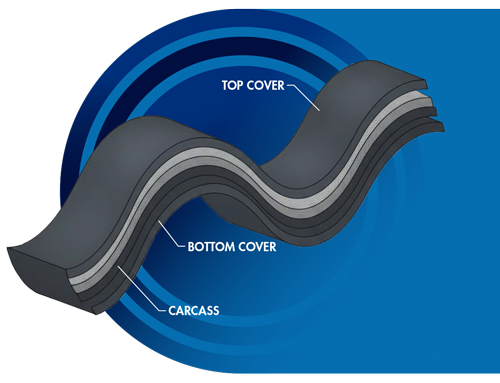
This illustration shows a typical conveyor belt construction conforming to international specifications. The all-synthetic fabric in the carcass is skim-coated with a cushioning layer of rubber.
Conveyor belting is classified according to the minimum full thickness breaking strength of the finished belt in kilonewtons per meter of width, in accordance with BS490, DIN22102.
Two cover qualities are available:
- 1. Rubber covers suitable for the conveyance of abrasive materials under average working conditions.
- 2. Rubber covers suitable for the conveyance of extremely sharp and abrasive materials under severe working conditions.
| Belt class for number of plies Belt | Belt Modulus kN/m | Class | Full thickness breaking strength | |||||
|---|---|---|---|---|---|---|---|---|
| 2 | 3 | 4 | 5 | Longitudinal direction min (kN/m) | Transverse direction min (kN/m width minimum) | Recommended max operating tension (kN/m) | ||
| 160 | 880 | 160 | 160 | 63 | 16.0 | |||
| 200 | 1111 | 200 | 200 | 80 | 20.0 | |||
| 250 | 250 | 1390 | 250 | 250 | 100 | 25.0 | ||
| 315 | 315 | 315 | 1750 | 315 | 315 | 125 | 21.5 | |
| 400 | 400 | 400 | 400 | 2220 | 400 | 400 | 160 | 40.0 |
| 500 | 500 | 500 | 500 | 2780 | 500 | 500 | Not specified | 50.0 |
| 630 | 630 | 630 | 630 | 3500 | 630 | 630 | 63.0 | |
| 800 | 800 | 800 | 800 | 4440 | 800 | 800 | 80.0 | |
| 1000 | 1000 | 1000 | 5550 | 1000 | 1000 | 100.0 | ||
| 1250 | 1250 | 1250 | 6940 | 1250 | 1250 | 125.0 | ||
| 1600 | 1600 | 8890 | 1600 | 1600 | 160.0 | |||
| 2000 | 2000 | 2000 | 200.0 | |||||
| 2500 | 2500 | 2500 | 250.0 | |||||
Cover mass
| COVER MASS | |||||||||
|---|---|---|---|---|---|---|---|---|---|
| Cover gauge (mm) | 1.6 | 2.25 | 3.2 | 4.0 | 5.0 | 6.3 | 7.0 | 8.0 | 10.0 |
| Mass of cover (kg/m2) - Grade 1 | 1.82 | 2.28 | 3.65 | 4.56 | 5.70 | 7.18 | 7.89 | 9.12 | 11.40 |
| Mass of cover (kg/m2) - Grade 2 | 1.78 | 2.22 | 3.55 | 4.44 | 5.55 | 6.99 | 7.77 | 8.88 | 11.10 |
Cover ratio
The ratio between the top cover and bottom cover gauges must remain below the specified maximum values in the table to prevent belt curling.
| Carcass Thickness (mm) | Maximum Ratio |
|---|---|
| up to 3.0 | 2.0 : 1 |
| 3.1 - 5.0 | 3.5 : 1 |
| 5.1 - 8.0 | 4.0 : 1 |
| 8.1 - 13.0 | 5.0 : 1 |
Need a belt recommendation for your application?
Send the material type, duty, width and working conditions and we can help confirm the most suitable class and cover combination.